Showing posts with label pedagogy. Show all posts

Tuesday, October 20, 2020

Getting the Kids out of the Pool/ Blindspots

What are your unquestioned practices? What are the things so ingrained (rightly or wrongly) that you can't even see them?

I'll share an example. For many years, I have directed a robust summer camp program. More than a decade ago, our outdoor pool was replaced by an indoor one. Over the years as new cohorts of campers moved through the camp, fewer and fewer campers swam during the afternoon free swim period. Yet we still sent them to the pool. We created extra duties for counselors to watch the kids who weren't swimming. We started ad hoc football and kickball games in the field adjacent to the pool for the kids were weren't swimming. We never questioned our basic practice that from 1-2:30 was swimming time. Finally, last summer, I proposed changing our schedule and this change was perceived as a big deal, I mean we were really proud of ourselves. For decades, afternoons meant swimming.

Now, no longer do campers have to go down to the pool area at this time. Why didn't I think of this half a decade sooner? Inertia is partly it. But more basic was that I had a blind spot towards this unquestioned practice that was no longer working; the most obvious solution never crossed my mind. Instead of changing the fundamental problem, I tinkered around its edges looking for solutions.

It is hard to see one's own blind spots. But it is not impossible. I take a personal inventory (almost) every day. I adopted this practice nearly 5 years ago. Because of this, it is harder for me to fool myself. In my professional life, I have a big and likely inflated ego about my teaching which lets me fool myself. I'm working hard to promptly admit when I am wrong. I think I am getting better at looking at myself honestly and critically. This at least lets me see opportunities for change when I am not actively fooling myself.

Be intentional
This look at oneself and one's practices has to be intentional. I make time to do it every day. Like an individual, an institution has to look at itself honestly and critically and OFTEN. I do think my school really is trying to update its mission and practices for 2016, but we are doing it right now because we are up for accreditation. We are trying to be honest and we are trying to be self-critical. But we have a hard time at looking at some basic assumptions maybe because we don't look at ourselves often enough.

Blindspots

  • My school has used the same report card for at least 40 years. I should know, because I was a student in this school in 1983. What are the assumptions we make about grading?
  • Why are so many of our tests full of "what" questions? What are the assumptions we make about tests?
  • Why do we continue to emphasize summative assessment at the expense of other tools? Why are our assessments always given at the end, and not during when the information could inform instruction?
  • Why do we group students of the same size and age together most of the day instead of grouping by interest and/or ability? Surely we do this because this is how it has been done since the 19th century. It is just what school looks like. 
  • Why is learning chunked into 40 minute periods? 


This is hardly an exhaustive list, but these questions are unasked and thus unanswered.  Traditions and institutional memory lead to tremendously powerful inertia.

Other blind spots? The people trying to fix and change schools and the people who are comfortable with the status quo likely were all very good at school themselves. It worked for them. This leads to all sorts of unquestioned assumptions and blind sports.

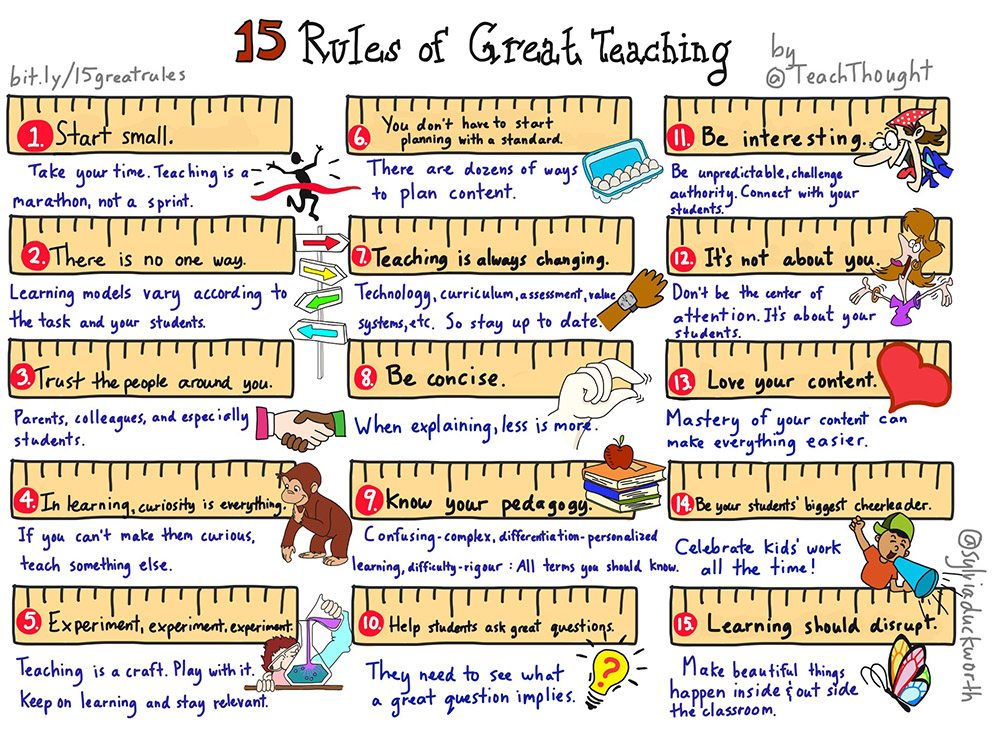


Monday, May 22, 2017

Rules of Great Teaching

Again I have come across Sylvia Duckworth's rules of teaching. I like all of them. My five favorites are rules 2, 5, 7, 9 and 13. Both pedagogy and content knowledge are important. I'd add a couple more to her list.
16.  Collect feedback constantly. A good teacher should constantly be gauging both formally and informally how it is going in the class.  
17. Let students play expert. The most authentic tasks asks students to be expert and share that expertise. 

What are your favorites on her list and what would you add to the list? 

Friday, May 5, 2017

Power and Privilege

I'm a mid-career teacher and truth be told, at 26 years in the field, I'm closer to being finished than I am to my start. At the start of my career, I planned to teach for a few years and then pursue a law degree. I wasn't gung-ho on being a lawyer, but I figured that's what I was supposed to do with the degree from the college I went to.

As a young teacher who knew nothing about teaching, I immediately assumed power. I seized the means of control. It's what a teacher was supposed to do, right? I gave permission for when students could stand and sit, speak and stay silent, and even when they could use the bathroom. Without a second thought, I grabbed this mantle of power.

I found I loved teaching- maybe I loved the power trip!- Nah, being more generous with myself, I stayed in teaching because I loved the kids. I loved coaching and I loved teaching history. Notice by the way, I didn't say I loved teaching students history. I was a lecturer. I learned a ton about history and I have no clue if my students really learned anything. Also in my first couple of years, I didn't have the best "control" over my students which caused me to seize the power ever more tightly.

Committed to giving this teaching thing a real shot, I went to graduate school. There I read Freire, bell hooks,  Nell Noddings and Vigotsky. It became apparent to me that my teaching was reinforcing all sorts of societal norms which I was opposed to in my own life. hooks called this the "banking system of education" based on the belief that recalling information and "regurgitating it represented gaining knowledge that could be deposited, stored and used at a later date."

Teachers, many whom are good progressives, keenly aware of the hidden and not so hidden structures of power in our world  - who consistently point these systems out when teaching literature and history! - reinforce these same systems of privilege and power in their teaching. They'd chafe at this assertion, but it is true. We reinforce the dominant paradigm even while we claim to oppose it. I've come across some Birkenstock wearing, vegan, natural fiber wearing, queer teachers who are profoundly traditional in their teaching approach. Is Freire wrong in his claim that the teacher as single authority needs to be re-adjusted if we want to create advocates for social justice? I think it is essential.

I teach a lot of rich kids who have or will have access to power. I feel my actions and methods will be more important than my words in creating people who will advocate for social and economic justice.


Featured Post

Prezi Video

 Remember Prezi? Once upon a time it was all rage for students. I see very few students use this tool any longer. Prezi is back, though, wit...