I came across this today. I found it, here. Unfortunately, the original source for this image can't be found.
What are my motivations for embracing digital tech? To be candid, I don't consciously think of them. But in reading these descriptions, I believe that Teacher 2.0, Motivator and Activist drive my interest in digital tech for the classroom. I also have a touch of ALT in me.
I'm not a techie. I don't use much tech outside of my iPad in my personal life. I don't play video games, I don't have the newest and coolest phones, gadgets and devices at home. I'm a relative latecomer to teaching with tech so I'm hardly a trendsetter, either.
What are your motivations for using tech?
The more I teach, the more I realize how much I don't know. This blog explores pedagogy and ed-tech.
Thursday, July 14, 2016
Wednesday, July 6, 2016
Risk and Failure
We say we admire risk-takers. Maybe that's true, but we do little to cultivate them in schools because we punish failure. AJ Juliani, one of my favorite bloggers and ed-tech writers, has written some posts celebrating failure. I love, love the idea of doing this. His class mantra is, "Sometimes you win, sometimes you learn." (I'm stealing that one for my class.)
There are so many sayings, cliches, and truisms about learning from failure. A quick google search finds gems such as:
![]() |
| https://www.flickr.com/photos/amboo213/4020584983 |
- “Success is most often achieved by those who don’t know that failure is inevitable.” - Coco Chanel
- “Only those who dare to fail greatly can ever achieve greatly.” -Robert F. Kennedy and this wouldn't be an ed-tech blog without a Ken Robinson quote:
- “If you’re not prepared to be wrong, you’ll never come up with anything original.”
Any honest self-assessment of schooling must lead us to the conclusion that we do not encourage risk-taking in schools. Failure is uniformly seen as bad. We either equate failure with lack of effort or we refuse to acknowledge the difference between them. A great teacher of mine, +Russ Walsh, used to talk about this in relation to the downsides of grading student writing. He posited that if we were going to punish kids (take away points/ give lower grades) for misspellings and grammar mistakes then our students were going to write a lot more safe (and boring) stories about big dogs than riskier stories about enormous pterodactyls. By punishing risk-taking and rewarding playing it safe we create kids who are risk-averse. I'd extend this argument to suggest that most school practices create kids who are risk averse. As long as we punish kids for mistakes (and don't say we aren't punishing them) this will remain true. Go ahead, take a risk! But risk a poor grade. It's a game only a rebel or sucker would play.
Next year, I will be teaching 12th graders, most of whom are very used to and very good at the traditional rules of the game and who have been trained to be risk averse and who are desperately worried about getting into college. I plan to incorporate some genius hour/ 20% time in the course. I will want to celebrate spectacular failure. I will want kids to aim high and think big. And when it doesn't work out, I will want them consider how to do it better next time. I hope I can pull it off, but if not I will remind myself that sometimes you win and sometimes you learn.
In the spirit of solidarity, I will also acknowledge and reflect upon my failures publicly with the students. This is going to be a very different kind of high school history course. It is my first time teaching it.
This will be a big paradigm shift for me as well. I like being successful. I'll let you know how it goes.
Friday, July 1, 2016
To Code or Not to Code, That is the Question. aka Worrying about the Future.
I'm being provocative in my title. Douglas Rushkoff, the author of
Learning to Code Yields Diminishing Returns doesn't actually argue that we shouldn't learn to code.
Instead, he argues that our post-industrial world has a problem to figure out, even formally bullish economists realize that we need to give something to workers to do. There are just not going to be enough jobs and education can't solve the problem. President Obama pointed out just the other day that we produce just as much steel in the USA as we ever did. The problem is that because of automation and technology, only a tenth of the workers are needed to produce just as much steel. For most of my lifetime, I'm 47, this phenomenon has been largely relegated to blue collar work and industry. For instance:
Jobs that I remember people having that my kids haven't seen:
- Elevator Operators (I remember when people use to control the elevator)
- Milkmen (and bread)
- Couriers
- Gas Station Attendents
- Travel Agents
Jobs that are quickly disappearing that my grandkids won't see:
- Mailcarriers
- Toll Both Collectors
- Supermarket Cashiers
- Drivers- Taxi, Trucks, Delivery, Etc..
Jobs like these helped produce a solid middle class which is being hollowed out. Our leadership class and those holding white collar jobs have yet to be massively affected and thus haven't really developed policies to address this problem. But they're next. I have a colleague who just left to form his own business. If he is successful, he will have basically developed technology that will put paralegals out of work. At Google Training, +Rich Kiker boldly predicted that much of what lawyers do will be replaced by digital technology. Though my teaching profession has been remarkably resilient to change, I fear that if schooling continues to primarily be about fact acquisition, I'm sure there will be fewer teachers as well.
The Trump phenomenon and the Brexit are both manifestations of the insecurity this transition has created. Rushkoff's point is that everyone learning to code will not make a difference. There will be only so many of these new jobs to go around. We need a new model. Rushkoff points to one in his new book Throwing Rocks at the Google Bus.
We really do need to figure this out. Otherwise, we are headed to leading meaningless lives as portrayed in WALL-E or we will be like the Roman mob in ancient Rome, hoards of displaced workers who were kept under control by bread and circuses.
Thursday, June 30, 2016
The New Google Sites
At last, Google Sites has finally updated! In actuality, it is more accurate to say that Google has invented something completely different and has given it the same name. It isn't an update at all. It is something brand new. Old Google Sites and the new Google Sites are nothing alike. There are some things that I like about the old Google Sites that can't be duplicated on the new version. The was an "announcements" setting in the old Sites which let me use Sites as a blog. There were also some layout options that I miss.
In terms of ease of use, there is simply no comparison. The old Sites used code from 2006. It was cumbersome and not particularly intuitive to follow. The new Sites couldn't be easier to use.
In regards to appearance, the difference is just as stark. The new is infinitely better than the old. Here is a recent but "old" Site of mine I built to house resources for a presentation I gave at Core Connections to Instruction & Technology Conference. Here is a "new" Site I am currently working on for a class I will teach in the Fall.
Right now, the new Sites is not totally ready for mass use. I'm accessing it through my school's GAFE account. I'm told that one might not actually see the new site if outside of my school's domain, so only my in-house readers will see if I understand this correctly. Here's some new Google Sites propaganda.
\
One question I haven't found an answer to is, will there be a way to migrate old sites into the new format? I've used Sites for student portfolios and would like for my students to eventually use this new and better tool without having to start from scratch. I'd like to think there might be a way.... because Google is amazing, but this is a totally different product.
And of course, when will this be workable on an iPad, the tool my school chose for our 1 to 1 program?
Tuesday, June 28, 2016
Twitter in the Classroom
I tried leveraging twitter in my HS history class this year. It worked okay. Kids didn't particularly like it. They thought I was forcing it. I see more uses for it in the course I am designing for next year.
In looking for cool twitter uses and users, I came across this twitter feed from a school in Maine. It is quite fantastic and is a great model for any classroom.
Wednesday, June 22, 2016
Optimizing Chances for Success
Differing views exist in the ed-tech/ ed. leadership world on how to foster "buy-in" in teachers. Some suggest a better approach is a bottom-up approach, letting change percolate from within. Others suggest a top-down style.
I confess to not knowing a best way. Surely my school has adopted the percolate model. If I take a loooonnnngggg range view, I can affirm that there clearly has been growth. However, there is no upward curve. One would suppose that a "tipping point" would occur and then everyone would adopt tech. If anything, the opposite has happened. There are small flurries of success but the larger community doesn't change.
Surely the LA iPad fiasco points to the perils of a top=down model gone awry. But the drip, drip, drip approach of teacher-led revolution seems unlikely as well.
Next year, my school's leadership will push technology in a more aggressive way. I've been told that each teacher will be required to meet with me at least monthly. I think I like this. Though I can point to real successes in my first year as Ed Tech Coordinator, I felt underutilized. I'm interested to see what next year's changes bring. Will they change the curve?
Saturday, June 11, 2016
Jerome Bruner
Jerome Bruner died on Thursday. My edu-geek is showing when I say I was saddened to hear this news. He was truly a giant in our field. NYT article on his passing.
I started teaching before I knew anything about teaching. I came to teaching from a liberal arts college where I received a rich education. I promptly tried to give that same education to middle schoolers. I forgive myself for that stupidity. It was 25 years ago. Despite my absurd practices, I decided I loved teaching and decided not to go to law school. Instead, in my third year teaching, I started my Master's degree.
Too often we hear teachers out of education programs wish they had less theory and more practical advice. I think new teachers are so busy surviving that theory goes out the window. When I started grad school, I had already survived my first three years. I was able to see how theory was helpful to practice. I learned pedagogy. An aside, we really need to rethink how we train teachers. We need something akin to a residency program, as doctors have. It would help us so much.) When I got to grad school, Skinner and Jerome Bruner were set up in contrast to each other.
I am bemused now by the young teacher that I was. I was totally a behaviorist. I didn't know/ hadn't known who Skinner was, but my model of education was based on rewards and rote learning and hard tests. In fact, I took pride in how challenging my tests were. Indeed, I even named my tests! That's right. I had a series of tests called, "Homicide", "Homicide II", "Suicide." I thought I was funny. Now I cringe.
![]() |
| Jerome Bruner |
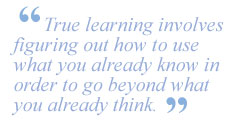
Reading Bruner showed me that I totally misunderstood how children learned. He showed me a cognitive theory of learning where learners "construct" meaning and understanding through a dynamic interaction with the texts, the instruction, and the environment. I've never been the same. I changed more between my third and fourth years of teaching than I changed in the rest of my career. I stopped giving grades altogether, I rarely gave tests, I tried to embrace a constructivist theory.
That's a long time ago now. But more than 20 years later, I think of constructivism often. I talk about schema theory far more than a normal person should. Ask my wife, when we go for walks I start talking about this stuff. I admit that I haven't really thought about Bruner himself- for a long time- if I ever did; I guess I thought he was already dead. Still, as I plan in-service training for teachers next week, his thinking will be guiding my thoughts probably more than anyone else I've read all these years later. How many other in-service programs this week will have Bruner's thoughts shaping the conversation? If the instructors are worth their salt, then almost all of them.
Subscribe to:
Posts (Atom)
Featured Post
Prezi Video
Remember Prezi? Once upon a time it was all rage for students. I see very few students use this tool any longer. Prezi is back, though, wit...
-
It is easy to gauge success as a teacher of students. It is harder to gauge success as a technology integration specialist. Why I am thrille...
-
The plural of anecdote is not data . That this Australian school is ditching iPads and going back to paper hardly constitutes a movement. Y...
-
This assignment really showed me technology's potential for making my classroom a more dynamic place. Yet, though this project had ...

