Monday, August 29, 2016

Gratitude !!

In the whirlwind that is the start of the year, it is worth reminding myself that I am extremely lucky to do what I do and where I do it.  Few professions so easily allow one to live a purposeful and meaningful existence as teaching.

I want to live joyfully this year. I believe that I have to recognize feelings of frustration and let them go before they influence me too deeply.

I am not my feelings. So, when I do allow my emotions to get the better of me, I have to forgive myself and let it go.

If I am feel rushed, overwhelmed or any other less than positive emotion, I will impart that to my students. I want to make my class a safe haven.

Last week at in-service, we were asked if we chose teaching over a more lucrative position. Virtually every teacher in the room raised their hand. I did too. So, I have to remind myself of this. I chose this for its rewards. They are many.


Friday, August 12, 2016

Put Away Your Laptops!

Folks skeptical of technology like to share articles (electronically, of course) proving the limits of ed-tech. The most common critiques are the related topics of cursive handwriting and note-taking.

There are hosts of studies and articles, such as this one from NPR and this one from West Point, suggesting that laptops inhibit effective note taking and thus detract from learning. 
"The students who were taking longhand notes in our studies were forced to be more selective — because you can't write as fast as you can type. And that extra processing of the material that they were doing benefited them." (Mueller)
I concede the point. I'll also concede that students are more likely to be distracted and off task. But, I do have  a few responses:

1) When we dig deeper into the study about West Point, we read, "Permitting laptops or computers appears to reduce multiple choice and short answer scores, but has no effect on essay scores." (emphasis mine)  Is learning about thinking or recall? Essays get to thinking, multiple choice questions get to recall. 

2) Do we teach students how to take notes digitally? The study shows that students with laptops type much of the lecture whereas traditional notetakers write only essential points because they cannot write as fast as they can type. However, there are tremendously powerful note-taking apps such as Evernote and Notability. Take a look at what Alice Keeler does with Google Keep. I suggest that the metacognition involved in the process she shares here is far different than transcribing the teacher's lecture. The video to the right is a fine tutorial on keep from the I Review Anything channel. Do we teach digital note-taking? 

3) Once notes are taken, technology can help a student organize them (via Evernote, Keep, Notability and countless other apps and extensions) and search within notes more efficiently. Suppose we taught students to only listen and type down main ideas instead of transcribing the lecture and then showed them how to search within their notes? I'd like to see a study commissioned about this. 

4) Studies show that students forget what they learn after a test. So, even if students do better in the short-term when taking notes by hand, does it matter at all that students do better on tests if they are going to forget it within weeks anyway? To say that students learn more in the medium or long term via handwritten notes is fundamentally untrue. 

5) I'll admit it, the lecture has its place. Sometimes it is the easiest and most efficient way to share knowledge.  Yet, studies such as these miss the point! As I've written recently, information is ubiquitous. It is accessible from anywhere. All of the world's knowledge is several clicks away. So, why don't classrooms reflect that? Why is lecture still the primary mode of instruction, especially in High School and College?

6) Information is ever-changing and ever-increasing. We simply can't know it all. In most professions, we should encourage people to look things up and not memorize. Harvard Medical School, hardly a wishy-washy progressive haven, recognizes this and has changed its program.

7) Technology allows us to significantly change the way we teach. These studies bemoaning tech use in the classroom are always in traditionally formatted classes. In some ways, these studies are all missing the point. 

There's a place for traditional note-taking. I concede that.
There's a place for lecturing and direct instruction. I concede that too.

For once, though, I'd like to see critics of ed-tech in school ask themselves some bigger questions about the point of schooling and learning and what we actually want students to be able to do. 


Wednesday, August 10, 2016

Where Frustration Meets Excitement and Vice Versa

 My job exposes me to amazing schools doing amazing things with technology. I too work at an amazing school but technology is not one of the things which make us amazing.

As teachers, as Americans, and as global citizens, we can get so much right and so much wrong in the next 30 years. I am not being pollyannish when I say that schooling can be transformed and made better for the vast majority of children. Yet, if we approach schooling from a paradigm of fear, we will continue to operate much the same way we have always operated. We see all too clearly how hope vs. fear plays itself out in our larger society across our country and across the world.

I am 47. When I was in school, the information I had access to began and ended in my school's library. Even through my college years, this was largely true. That's when libraries used to brag about the size of their collection and how many journals they had. Schools honestly were not different than medieval monasteries in that knowledge was housed. Technology now allows for all of the world's information to be at our fingertips, accessible from anywhere at any time. This change is fundamental but this change has not changed the way most teachers teach or how society views education.

This societal view and how it shapes what goes on in school is essential to understand. The societal view of schooling is a fearful view. For more than 50 years, education has been "in crisis" in the USA. Indeed, as Gerard Bracy writes:

 "The schools never recovered from Sputnik. Sputnik wounded their reputation and, as the scab formed, something else always came along to reopen the lesion: In the 1960s, schools were blamed for the urban riots (but were not credited for putting a man on the moon). In the 1970s, they were seen as “grim and joyless”. . . In the 1980s, A Nation at Risk blamed them for allowing the Germans, the South Koreans, and the Japanese to race ahead of us competitively (yet did not credit them for the longest sustained economic expansion in the nation’s history)."

When do we look at possibilities? Can we operate from a paradigm of hope for the future instead of a fear?

(Forgive me an aside. How come whenever Governors and Presidents create "blue ribbon panels" to reform education these panels are largely devoid of teachers? I'd have loved it if a panel of teachers was created to make sure the Mortgage Crisis of 2008 never happened again.) Aside over....

We are afraid to change because we worry that something essential will be lost, that important skills won't be taught. Instead of thinking what can we do differently, we worry instead about how we can stay the same while adding a layer of technology on the top.

I find most teachers who don't change are that way because they are afraid of technology, afraid of no longer being the expert in the room, and fundamentally are afraid that essential skills will be lost.

We are well into this 21st century. We've been talking about "21st-century education" for quite awhile now. Sadly, it looks much the same as 1980's education in too many schools and classrooms.

Thus I find myself simultaneously excited and frustrated much of the time. I see and read about pockets of brilliance and then run into walls erected out of fear.

Monday, August 1, 2016

Going Paperless in your Classroom? Why?

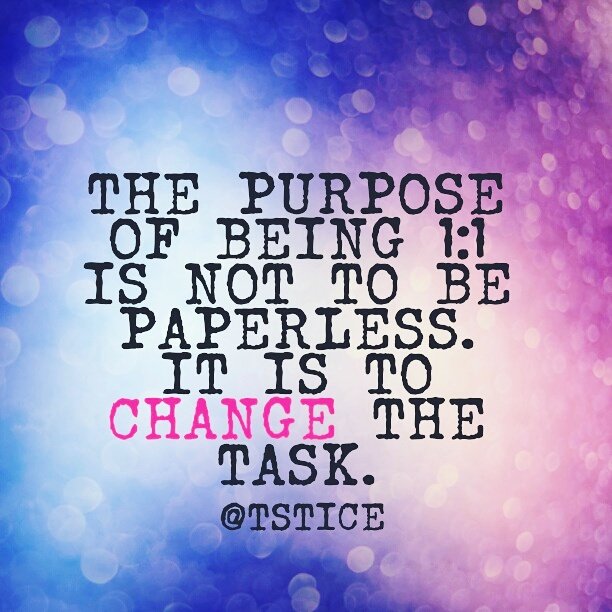
Somehow going paperless got mixed up with ed-tech and the idea of transforming classrooms with technology.  Saving paper is a good thing. But in and of itself, it has very little to do with effective tech integration. Why use digital technology to mark up pdfs and grade papers when it is easier to do it with paper? The question we should be asking is, "Does technology improve the task?", not "Am I saving paper?". Saving paper should be a byproduct and not a goal. When I first 1-2-1, I got this confused. I spent much needless aggravation trying to go paperless.

The point of digital technology is that information is ubiquitous, it can be accessed anywhere through many different ways. The whole very model of teacher as the font of information can and should be changed. That's what technology allows us to do.

By the way, I do think kids should use technology when writing papers. Why? Because with Google Docs I can:
1) check students' revision histories
2) have them build bibliographies instantly and without fuss
3) using Draftback, actually view a "movie" of the student writing the paper.
4) give feedback in real time
5) allow students to collaborate in real time from separate locations on the same paper.

Alice Keeler has written extensively about this. Check her out. I remain amazed by her volume and usefulness of her output.


.@wolfbioedu @KLBoles @tstice pic.twitter.com/JJ6xPE3LYj

Friday, July 29, 2016

Chrome Extensions and Add-Ons I Like or Why Chromebooks Rock


Back when the Chromebook was just coming out, many people thought the google apps for school were just not robust enough in comparison to the Apple operating system and Windows. I remember teachers and parents complaining that Microsoft's Office Suite was far superior to its Google counterparts. In the face of some of these complaints and concerns,  my school eventually chose the iPad over the Chromebook.  At the time, a solid case could be made. However, in the four years since that decision , many of the arguments against Chromebooks no longer can be made. I am not alone in feeling this way. 

Google has made vast improvements. One of the ways they have made these improvements is an ever increasing array of extensions and add-ons. This mass array of free software (not so on iPad) in my mind gives Chromebooks the edge in addition to the reasons cited above in the article. I use these free apps and extensions all the time.


Here are some of the extensions I use the most:

  •  EdPuzzle. EdPuzzle lets me quickly edit YouTube videos for class. I can even embed questions for students to answer.
  • Snagit. A simple screenshot capture tool. I use this so often.
  •  Draftback. This one is a game changer. This basically takes a movie of a paper being in written. Imagine meeting with a students and replaying at a slightly faster speed them writing their papers? There are powerful learning and teaching moments in doing that. Its very viewing promotes metacognition in the student.
  •  Flip It. Works in conjunction with Flipboard. I can easy and quickly add articles I like into any Flipboard magazine.
  •  The QR Code Extension. It instantly lets me make a QR code of any webpage I'm on.

Google "best chrome extensions" and you'll be amazed at the seemingly endless amount of functionality you can add to your Chrome experience.

     Add-ons, on the other hand, add functionality within a particular google app such as sheets or docs. Below is a screenshot of my add-ons in google docs. Admittedly, it is blurry, but you can see how to access add-ons. It is right there in the menu bar.
  Within docs,  I really like Mindmeister. It is a great mapping tool for writing.  My list also includes EasyBib, Easy Accents (great when trying to type in a different language) and ProWriting Aid. 
   Within sheets, Doctopus is a great tool for editing student work. I've also used the SiteMaestro add-on to share google site a common but individualized google site with students. 

   I've shifted from being slightly in favor of iPads as the best tool for students to overwhelmingly feeling that Chromebooks are the best tool. Add-ons and Extensions are a significant reason why I feel that way.  

Tuesday, July 26, 2016

Ubiquitous

TedTalks have become clichéd. But I still watch them because once in a while, I come across one that profoundly moves me.  Dr, Zimbardo's talk on the psychology of evil was one such talk. Watch it if you have the time. He explains what a powerful class experiment taught him about the nature of evil.

Recently, I've run across another. Michael Wesch, like Zimbardo, is a college professor. He posits that in a world in which there ubiquitous computing, ubiquitous communication about everything from everywhere at unlimited speed on all kinds of devices we need to shift our education goals from making students "knowledgeable" to "knowledge-able". That might seem too cute a first glance. But it really struck me. I had a light bulb moment. I've articulated thoughts like this in this blog more than a few times. But I've not heard it put so perfectly or pithily. Anyway, watch and enjoy.  

Tuesday, July 19, 2016

Are There Always Two Sides to Every Story?

This post is about when teaching bumps into politics and isn't about technology. Stop reading if you don't wish to read about politics.

I'm a Democrat. I'm 47 and haven't voted for a Republican at the state or national level since I was 26. (I routinely vote Republican for local school board but that's a different story). I loathed Bush as a president. But he's a decent human being and a patriot. Mitt Romney, I actually liked. He too is a fine human being. So were Bob Dole and Pappy Bush. I've been a teacher through every election since 1992. Early in my career, I told kids who I was voting for. More recently, especially in 2008 and 2012, I consciously and deliberately avoided tipping my hand in any discussion about politics. I've come to think of taking sides is an abuse of power.

My school is rightly struggling with how to talk about Donald Trump. My school's student population votes overwhelmingly democratic in every mock election. The parent body is very liberal. If anything, the faculty is even more liberal. Over the years, I've thought that some teachers have been far too partisan. Republicans aren't idiots  Republican students have been made to feel that way.  We shouldn't have waded into debates about Obama vs. Romney and Bush vs. Gore. The institution itself practically celebrated after Obama won in 2008. That was wrong. 

As a reaction to this, our administration had us talk about the 2016 election at the end of year faculty in-service meetings and specifically what to say about Donald Trump upon our return to school in the fall. Passions will be high. Our students are engaged in politics. It isn't easy running a school. I'm sure administrators have received loud and clear feedback from our few conservative parents over the years. 

Right message. Wrong year for it. 

Trump is different. He dabbles dangerously with the racist right (don't think I am accusing the right as racist- I'm talking specifically about the so-called alt-right.) He wouldn't even disavow David Duke, the KKK leader.  He has posted anti-Semitic images. His anti-Latino and anti-Muslim views are toxic. 

Are there two sides to every story? I know and like some Trump voters. Some are in my family. They feel he doesn't really mean all he says and they feel he is a breath of fresh air and that he will disrupt politics as normal in DC. On the other hand, I fear this is what fascism looks like when it comes to America and I'm scared. 

I am in conflict. I will abuse my authority in speaking out. I will be complicit with racism in staying silent. What will you do reader? 

Forgive my foray into politics. I promise I'll go back to tech posts. 


Featured Post

Prezi Video

 Remember Prezi? Once upon a time it was all rage for students. I see very few students use this tool any longer. Prezi is back, though, wit...