Sunday, January 22, 2017

Portfolios Part 2- Science Class

The sciences seem like natural places for portfolios because so much student learning is already assessed and measured outside of tests. Of course, I think of labs as I write this. This stuff of science is exactly the kind of work that should end up in a portfolio. 

Remember, portfolios show learning over time. Remember, they must allow for student choice, a self- evaluation of what best showcases their learning is central.  Students are to consider their strengths and weaknesses, and how to improve.

This pdf, made by science teachers is a terrific, ready made tool easily adaptable to any portfolio format.

In an Edutopia post, cool cat teacher Vicki Davis (follow her by the way) writes:
How will the portions of your portfolio relate to standards and coursework? Can you use portfolio assignments as advance organizers?
In the Marzano Center’s new book Identifying Critical Content, the authors discuss the importance of effectively cueing critical information. One of the concepts discussed is the advance organization of content, a term coined by psychologist David Ausubel to describe helping students understand the content of a section before it is introduced.
For a science portfolio, you could introduce a unit on water quality by informing students that they will be preparing a section of their portfolio where they'll explain how water quality can be assessed. They can write their opinion beforehand while quoting the data and charts from their learning. In this example, you've told students what will be covered so they can begin with the end in mind. So at the beginning of a unit, you can share what type of evidence they’ll be collecting for their portfolio, and you can relate standards to outcomes more clearly using portfolios as advance organizers.

My colleague +Padraig Barry  could have his students place their Mars projects in their portfolios. Similarly,  +Patricia Zaradic should have her students placed their impressive stream study google sites into their portfolios. I am sure that every teacher can think of something right away that every student could and should add to a portfolio. But a portfolio isn't just a place to house work. It is a place for students to reflect upon work. Otherwise, we rob portfolios of their value.

This article is aimed at the high school teacher, though teachers of younger students will find it useful as well.

By the way, if you want to make your own Keep Calm poster, go here 

Thursday, January 19, 2017

Portfolios: Ideas and Tips for Portfolio Work, Part 1 Foreign Language and Math

Now What?

So let's say you, the teachers, in a rush of enthusiasm (or momentary madness) agreed to adopt digital portfolios. Now what?

What actually should go into a portfolio? Below are links to different sites suggesting how to incorporate portfolios into your class. Today's post will feature portfolio use in the foreign language and math classroom. Later in the week, I will add resources for other subjects and include some thoughts and resources on using portfolios in parent/ teacher/ student conferences. 

Foreign Language
   Get kids speaking in the target language. Record them every two weeks. Have students put these recordings into their portfolios. You could, will little effort, track a student's progress in oral fluency in the target language. To add a step, have students make tutorials or little movies using iMovie and Explain Everything. 
    Here is a vintage GoogleSite, the same tool the students are using for their portfolios, full of great ideas for portfolios in the foreign language classroom. 
     I have to think there are obvious ways to use the portfolio in this way. This website explores the convergence of language Acquisition and the arts. What a better way to use a portfolio?!

  Latin
   Here is a very interesting way to actively use the portfolio in class. It wasn't quite what I had in mind, but it seems quite useful. 

Math
   This article, from the pre-digital days, shows how an algebra teacher uses portfolios in her classroom. It is easy to apply this to our now digital portfolios.

This site provides a good framework for students as they think about about what they could and should add to their portfolio. There is a strong self-reflective component built in. This also is pre-digital but it could be easily incorporated into our digital platform.

I've only read the first 15 pages of this long article in pdf, but the first two chapters seem very useful in showing how to use portfolios in the math classroom.

The latter half of this pdf is full of excellent resources and ideas for leveraging portfolios in math.


Wednesday, January 18, 2017

A balance

I've never liked the notion that we teachers don't live in the real world. This school in which I work is the real world to my students. At the same time, school should protect kids from the worst of the world and provide them with the best of what the world can offer. School should be a refuge of learning, a safe, nurturing place. Isn't that okay?

To my fellow disappointed Democrats, please let kids be kids on Friday. I've heard whispers that my school should cancel our scheduled Spirit Day. No, please no.

Let kids be kids.

Friday, January 13, 2017

Student Leadership and Authentic Work

I sit here in the midst of a student-led practice session for the Model UN to be held at University of Pennsylvania in two weeks. These kids are staying after school from 3-7pm at the start of a weekend. Right now, their energy is sky high. They are well prepared, articulate and intelligent. I wondered last year why schooling couldn't look more like clubs such as this. At the time, I emphasized the importance of student agency. Watching this this evening reaffirms this belief. These kids choose to be here because the are interested by the topic. I'm struck by the power of an authentic task (even if it is only a simulated authentic task). I think mostly anything that asks students to play the role of expert becomes an authentic task.

I have a super trio of seniors who are running this session as I write this from the third row.
I chime in now and then from my third row perch with some advice, but it is clear to them and to me that their roles are essential. I'm here to keep order; I edit some of their papers; I give some speaking tips; I control the money; I supervise the sleeping arrangements; and I'll make sure they behave themselves in center city Philadelphia. I set up the Google Classroom page, I give advice to a student now and then and give my super trio some advice once in awhile.  I communicate with the Model UN company. Why can't at least of this be replicated in the classroom setting?  I have important essential roles, but I don't have to run things. I leave that to the trio.

Real learning is going on for everyone involved in this process. Authenticity has something to do with this. Students are presenting their work to a real audience. This borrows from the best of problem based learning because students are scouring the internet through this whole process to find information they can use in real and meaningful ways.

There is something too about the almost frenetic pace and overall "busyness" of this session. Ideas quickly fly about the room  even though the format is formal and highly structured. I have to think more about this as I've never been in a rush in the classroom. Maybe I sometimes should provoke kids to be in a hurry.

The answer to interesting and engaging humanities teaching isn't Model UN for everyone, but surely much this can be replicated in the classroom.

A few final thoughts.
-Students are writing good papers without the motivation/ threat of grades. I've long said we need to divorce grades from learning. They have very little to do with each other. I know I'm tilting at windmills. But gosh, the evidence is right in front of me right now.
-I have 9th through 12th graders in the room. I like the mentoring that the older students give to the younger students. I like the leadership opportunities clubs like this offer. Can we do more to blend learning experiences in school? I understand why math and foreign language class have to group students by ability. But why can't we mix 9th through 12th graders more in other classes. "To teach is to know," right? If that's true, let the kids teach each other.


Wednesday, January 11, 2017

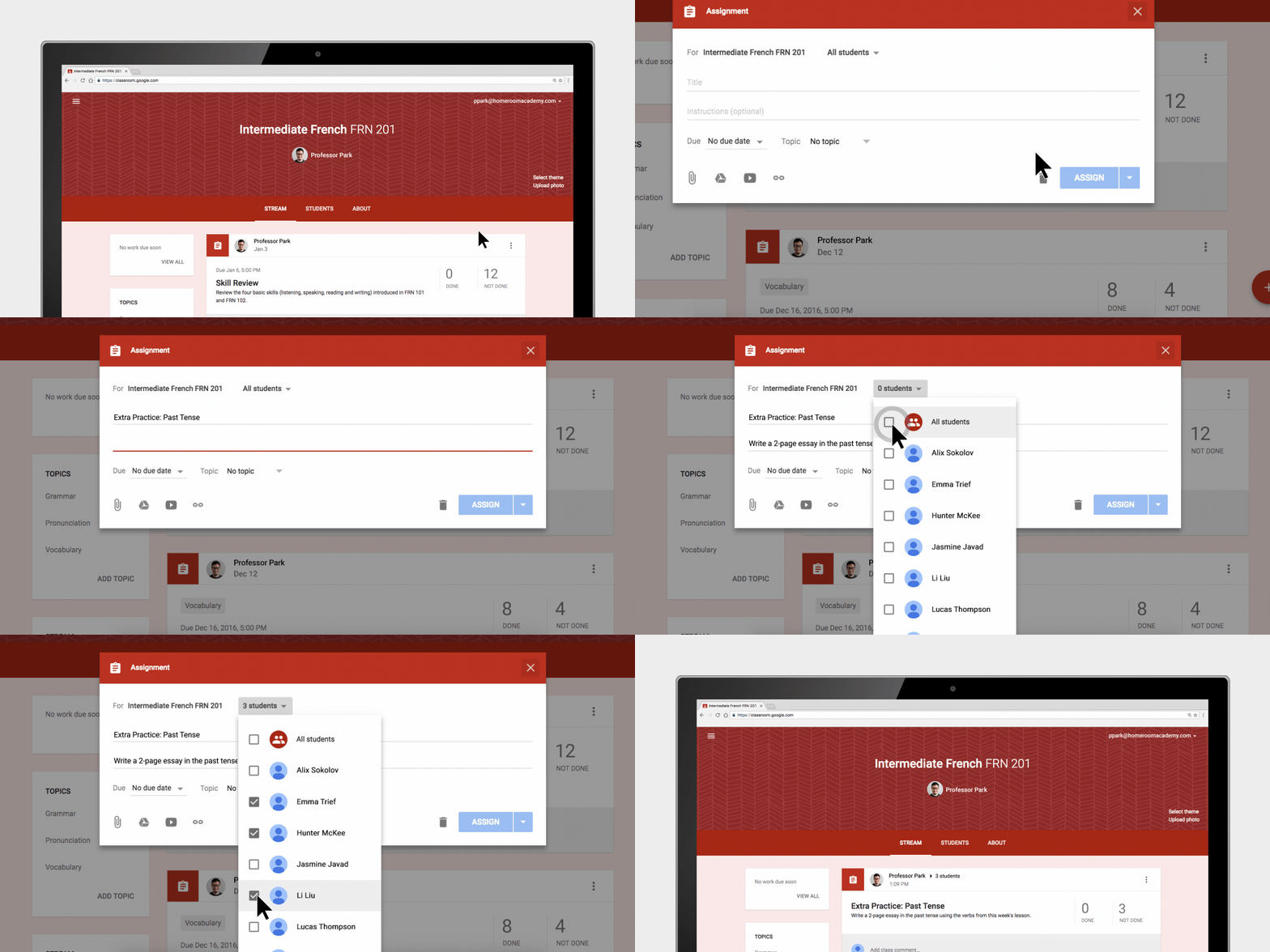
Nice new Google Classroom Feature

This is very helpful. Thanks Google! I can now send work to individual students or groups of students instead of sending work to whole class.

Want to use Google Classroom AND differentiate instruction? Now it's easier. I know I will use this new feature quite a bit.

Build a School on Mars Challenge

My colleague +Padraig Barry and I took AJ Juliani's Mars Challenge to a 6th grade science class. It was the best of PBL. The task allowed for creativity, real science thinking, teamwork, writing, and tech use,

One student bemoaned the lack of "hard" science and wanted to get back to the "real stuff". It is interesting that we already have trained the kids that lecture and testing is "real" by 6th grade. While this is worth exploring further, I won't address it here even though I wanted to acknowledge that not every kid liked it. And that's important to note. Some kids don't like pbl. Be forewarned.

Padraig Barry, the classroom teacher writes, "I normally incorporate a host of projects into my sixth grade curriculum, but his one was somewhat different.  Usually, a project is based on a specific topic that we are covering in class and is broken into discreet segments. The MARS project was more student-driven and I was very impressed by just how much the students and their partners took ownership of their own project."

Padraig also observed that this played to different strengths and weaknesses in students. Some of his stronger students in a traditional classroom setting struggled with the more open- ended tasks. Some students, whom Padraig considers to be on the shy side, blossomed while doing this project and showed sides of themselves he had not previously seen.

It is worth distinguishing between project and problem based learning. While these terms are used interchangeably, they aren't indeed the same thing. One can have students do projects that aren't problem based.  I think this is the difference that Padraig, my colleague, is getting to. There is something fundamentally different about an open ended task whereas most of his projects which he refers to above have a specific end goal in mind.

I thank Padraig for his willingness to give up time and "coverage" to do this project. It isn't easy to do. I am also very grateful for his willingness to trust. I found out about this contest relatively late in the game and with almost zero advance notice he was willing to change his plans to do this project.

Here is one of the finished student projects.


I will post the other two tomorrow.


Tuesday, January 10, 2017

Alice Keeler and Matt Miller, Gurus.


I'm amazed by the ever improving functionality of the chrome browser and google apps because of the flood of add-ons and extensions. I've written about them a lot. Their only downside is the sheer volume of them. It is hard to stay current and to always know what are the best of these. Also, my bar next to my omnibox is getting very very crowded with chrome extensions. Yes, I quibble, but this does get to my point that this is all a little bit unwieldy. Still, the positives overwhelm my quibbles.

To stay current, no one is more useful than Matt Miller's Ditch that Textbook blog and Alice Keeler's blog. Alice is more of a "how to" guru for all things Google while Matt challenges the status quo in education. That's not quite fair to either of them for Matt shares plenty of "how to's" and implicit in every Alice Keeler post is the idea that there is a better way to do things.

Seriously, follow these two bloggers. Recently, like the Wonder Twins, they combined forces to create a very useful chrome extension of which I post the video below. Alice and Matt help me stay on top of this flood of information. I once heard that staying current with tech is like drinking from a fire hydrant.  These two help me stay current and more importantly help me see how tools such as these can transform education.


Featured Post

Prezi Video

 Remember Prezi? Once upon a time it was all rage for students. I see very few students use this tool any longer. Prezi is back, though, wit...